What your resume score actually means (ATS vs. hiring-manager read)
You ran your resume through a checker and got a number. Maybe it said 72. Maybe it said 91. Either way, the question that matters isn’t “what’s my score?” — it’s “what is this number even measuring, and does it predict an interview?” Most tools hand you one figure that quietly conflates two completely different questions. This guide breaks the resume score into the two things it should actually tell you apart: whether a machine can read your resume, and whether a human wants to call you.
Why one number is the wrong answer
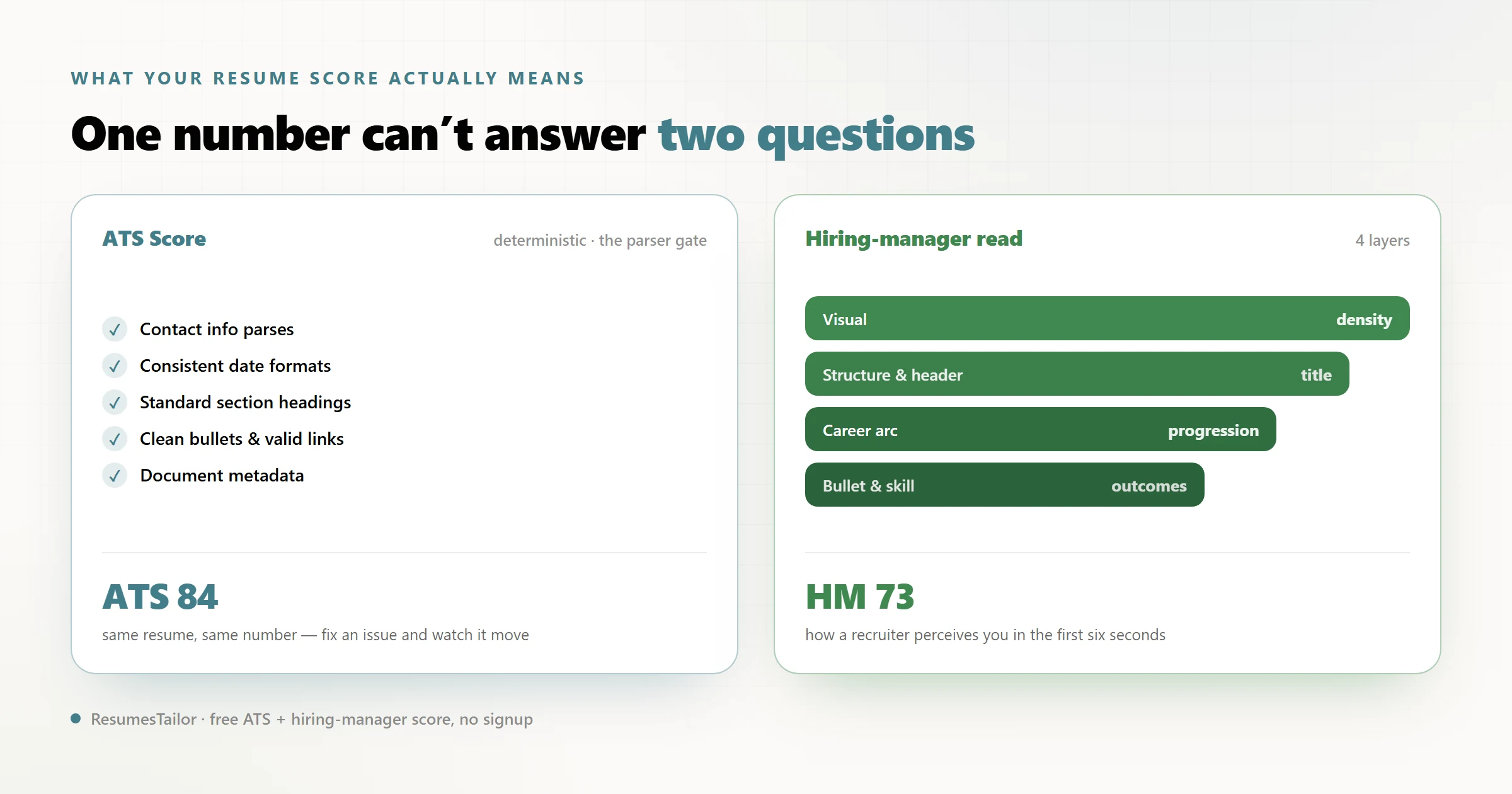
A resume has to clear two very different bars, and they have almost nothing to do with each other. First, an applicant tracking system has to be able to read your file — parse your name, contact info, titles, dates, and bullets into structured fields. Second, once it clears that gate, a human has to want to interview you after a few seconds of scanning. A single blended score can’t represent both, because a resume can ace one and bomb the other. So we run two engines and show you both numbers: an ATS score and a hiring-manager read.
You can see both numbers for your own resume in seconds — paste the text or drop the PDF into the free ATS resume checker, no signup required. The rest of this guide explains what each number is measuring so you know which lever to pull.
The ATS score: can the machine read it? (deterministic)
The ATS engine parses your resume the way an applicant tracking system does and checks the mechanics that make or break parsing. None of it is a judgment call — it’s a checklist of things that are either present and consistent, or not:
- Contact parseability. A detectable phone, a valid email, and a location field the parser can actually extract.
- Date consistency. One recognizable date format throughout — not “Jan 2024” in one role and “01/24” in the next.
- Standard section headings. Canonical labels like Experience, Education, and Skills — not clever ones the parser skips.
- Consistent bullet symbols and valid links. One bullet character, and a LinkedIn or portfolio URL that actually resolves.
- Clean document metadata, plus a flag for likely spelling errors.
The critical property here is that this score is deterministic — the same resume always yields the same number. That’s what makes it useful: you fix an issue, re-check, and watch the score move. As a rule of thumb, 80 and above is strong, 60 to 79 means there are clear parsing or formatting issues worth fixing, and below 60 means an applicant tracking system is likely mangling part of your resume before a human ever reads it. If you want the deeper mechanics of how parsers drop, merge, or misfile content, we wrote a full breakdown of the best ATS resume checkers and what each one actually tests.
The hiring-manager read: will a human call? (four layers)
Clean parsing gets you past the machine; it doesn’t get you the interview. Most rejections happen after the ATS pass, at the recruiter’s eye. So the second engine scores the human read — and because recruiters don’t read evenly from top to bottom, it’s broken into the four layers they mentally run through:
- Layer 1 — Visual. First-impression density, page length versus your stated seniority, and overall scannability. A wall of text, or two pages for eight months of experience, triggers an instinctive “next” before a single word registers.
- Layer 2 — Structure & header. Whether your header carries a clear current title and your sections are ordered the way a recruiter expects. This is where “Passionate, driven engineer” loses to a one-line summary built around a quantified outcome.
- Layer 3 — Career arc. Whether your roles tell a coherent progression story rather than a flat list of jobs. Did scope actually grow, or did you zig-zag laterally?
- Layer 4 — Bullet & skill quality. Strong action verbs over duty phrasing, measurable outcomes over responsibilities, and a focused skills section over a laundry list.
The layers cascade. If Layer 1 fails, the recruiter may never reach Layer 4 — so a beautiful deep read can’t fully rescue a cluttered first impression. That’s what makes the read believable in a way a flat keyword count never is. We go deep on the cascade and the timing of each layer in ATS Score vs. Hiring Manager Score.
ATS score vs. hiring-manager score: what’s the difference?
The ATS score answers “can the software read my resume?” It’s mechanical and deterministic — formatting, fields, parsing. The hiring-manager score answers “does a recruiter want to interview me?” It’s about content and story. You can have a perfect ATS score and a weak hiring-manager read — clean formatting, but every bullet describes a duty instead of an outcome. Or a strong human read that an ATS still mangles — compelling content trapped in a two-column template. A resume that gets interviews scores well on both, which is exactly why a single number hides the problem and two numbers surface it. For the full head-to-head — including why the keyword “ATS score” most tools ship is so easy to game — see the real way to test your resume in 2026.
Free score vs. a free account
Scoring your resume is free and needs no signup or credit card — you get your ATS score, your hiring-manager score, and a preview of the highest-impact issues. Creating a free account unlocks the full list of findings and a one-click fix for each one inside the editor, where you can rewrite weak bullets, standardize dates, and re-export an ATS-clean PDF. The score stays free; the account is for actually fixing what the score surfaces. And to be clear on privacy: your resume text is processed to compute the score and is not stored — a shared score contains only the numbers and issue categories, never your raw resume text.
Frequently asked questions
How do I check my resume’s ATS score?
Paste your resume text — or upload the PDF — into the free checker and submit. In a few seconds you get two numbers: an ATS score that reflects how cleanly an applicant tracking system can parse your contact info, dates, headings, and formatting; and a hiring-manager score that reflects how a recruiter reads your bullets, verbs, metrics, and career arc. You also see the top issues to fix first. No signup required.
Is the resume checker free?
Yes. Scoring is free and requires no signup or credit card. You get your ATS score, your hiring-manager score, and a preview of the highest-impact issues at no cost. A free account unlocks the full list of findings and a one-click fix for each one — but the score itself is always free.
What is a good ATS score?
As a rule of thumb, 80 and above is strong, 60 to 79 means there are clear parsing or formatting issues worth fixing, and below 60 means an applicant tracking system is likely mangling part of your resume before a human ever reads it. Because the ATS score is deterministic, you can fix an issue, re-check, and watch the number move.
Is passing the ATS enough to get an interview?
No. Passing the ATS only means a machine can read your resume — it says nothing about whether a human wants to interview you. That’s why the second engine exists: the hiring-manager read scores what a recruiter reacts to in the first few seconds — weak versus strong verbs, missing metrics, generic filler, an unclear current title, and whether your career arc tells a coherent story. A resume needs both.
How does an ATS parse my resume?
An applicant tracking system tries to extract structured fields — name, contact info, titles, dates, and bullets — reading top to bottom and expecting standard section headings. Tables, multi-column layouts, text boxes, headers and footers, and inconsistent date formats are where parsing breaks: content gets dropped, merged, or attached to the wrong field. The ATS engine checks exactly these mechanics so you can see what a parser would actually capture.
Should I submit a PDF or paste text?
Either works. Pasting plain text is the fastest way to get a score and is a good proxy for what an ATS extracts. Uploading a PDF lets the checker read the document the way a parser does. Scanned or image-only PDFs can’t be scored — there’s no extractable text in them, so paste the text instead.
Do you store my resume?
No. Your resume text is processed to compute the score and is not saved to your account or kept on our servers. Only the scores and findings are retained, and only if you explicitly choose to save or share them — there’s no raw resume text in a shared score.
Ready to see your two numbers? Run your resume through the free ATS resume checker — paste the text or drop the PDF and get your ATS score and hiring-manager read in seconds, no signup. Then create a free account to unlock every finding and fix it in one click. Next, learn the 5-step framework for tailoring your resume to a job description so the score you just earned converts into interviews.
Build, tailor, and get referred — free
ResumesTailor tailors your resume to any job description, surfaces the right referral contacts inside the company, and drafts the outreach — all in one workspace. Free forever, no credit card.